
Start Here: The Complete Guide to Selling to Procurement
From someone on the other side of the table.

Most sales training teaches you how to pitch.
But when you sell into companies with formal procurement, pitching is what gets you blocked.
This blog explains how buying actually works from the procurement side—and how to align your outreach with that process instead of fighting it.
Bookmark this page. It’s the roadmap to everything you need to know.
What You’ll Learn
This is a comprehensive guide to procurement-focused selling, organized into three parts:
Part 1: Understanding the Buying Process
How procurement decisions really happen (and why vendors get blocked)
The 4-step decision chain (and where most reps enter too late)
Common myths about procurement that kill deals
Part 2: Outreach That Gets Forwarded (Not Deleted)
The difference between “personalization” and relevance
Email templates that get responses from buyers
How to get introduced to procurement (instead of cold-pitching them)
Part 3: Assets & Tools
The Procurement Email Scorecard (test your emails before sending)
Role-specific contact strategies (by function and category)
Monthly playbook updates (Paid subscribers only)
Reading time: 12 minutes for the full guide
Best for: SDRs, AEs, Marketers and founders selling B2B with deal sizes >€50k
Part 1: Understanding the Buying Process
How Procurement Decisions Really Happen
Procurement doesn’t “discover” vendors.
Here’s what actually triggers a procurement process:
Someone internal has a problem (downtime, cost overrun, compliance risk, capacity constraint)
That person researches solutions (Google, peers, industry groups—not cold outreach)
They build a business case internally (ROI, timeline, risk assessment)
Budget and stakeholders align (CFO, department head, technical validation)
Procurement formalizes the process (RFP, vendor evaluation, contract negotiation)
The mistake most vendors make: They try to start at step 5.
By the time procurement is involved, 70–80% of the decision is already made. The vendor shortlist is often set. Your job isn’t to “pitch procurement”—it’s to get pulled into steps 1–4 by the actual problem owner.
Want the full breakdown of who to contact first (by industry and category)?
Paid subscribers get the complete Decision Chain Map + role-specific templates.
Deep dive article:

The 4-Step Decision Chain
Every procurement-involved deal follows this chain (whether formal or informal):
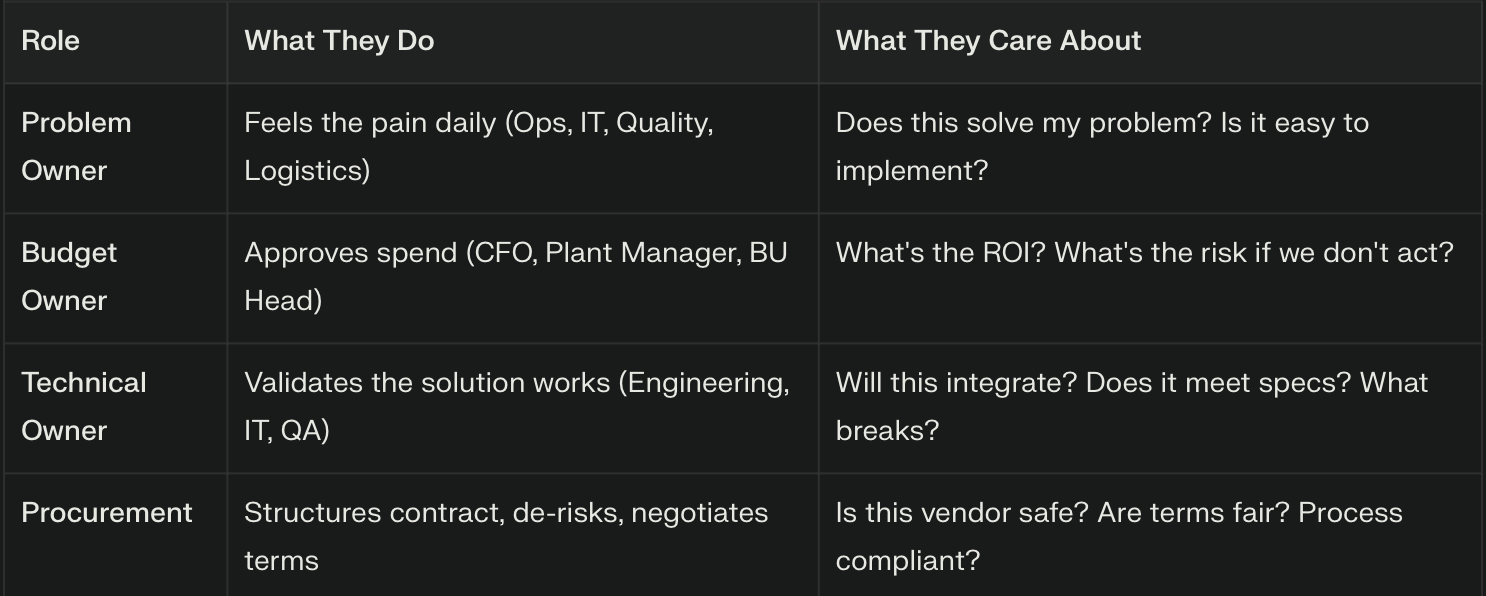
Key insight: If you win #1–3 before contacting #4, procurement becomes an accelerator. If you skip to #4 first, procurement becomes a blocker (because no one internal is championing you).
Common Myths That Kill Deals
Myth 1: “Procurement controls the budget”
→ Reality: Budget owners (CFO, BU heads) control spend. Procurement enforces process and mitigates risk.
Myth 2: “I need to get on the approved vendor list first”
→ Reality: Approved vendor lists exist for repeat/low-risk buys. For strategic purchases, internal champions get you added to the list.
Myth 3: “Procurement wants the cheapest option”
→ Reality: Procurement wants the lowest total cost of ownership (TCO) and the lowest risk. Cheap vendors who create downstream problems get blocked fast.
Deep dive article:

Part 2: Outreach That Gets Forwarded (Not Deleted)
The Relevance Test - Use This on Every Email
Most “personalized” emails fail this test:
“If I replace the company name with a competitor, does this email still make sense?”
If yes → it’s a template with variables, not real personalization.
If no → you’ve referenced something operationally specific.
Bad example:
Hi [Name], I noticed [Company] is growing fast. We help companies like yours optimize procurement. Can we chat?
(This works for any company. Zero signal of real research.)
Good example:
Hi [Name], saw you’re opening a second distribution center in Q2. When companies do this, procurement usually gets involved either (a) early to standardize vendors across sites, or (b) late when costs spiral. Curious which path you’re on?
(This only works if they’re actually opening a DC. Operational signal = real relevance.)
Email Template Library
Template 1: The “Forwardable” Email
Goal: Get forwarded to the actual problem owner (not stuck in procurement’s inbox).
Subject: Quick question—who owns [problem] on your side?
Hi [Name],
When [signal: new plant/system/expansion] happens, the downstream issue usually shows up as [cost/delay/risk] for the team running [function].
Procurement typically gets looped in once there’s a preferred vendor—so the commercial step is just structure.
Who owns that workflow today—[Role A] or [Role B]?
If you point me there, I’ll send them a 3-line note they can forward back to you when it’s time to formalize.
— [Your Name]
Why it works: Respects the buying chain. Makes procurement’s job easier (pre-aligned deals close faster).
Template 2: The “Not Me” Disqualifier
Goal: Stop wasting time on dead accounts (and earn respect through honesty).
Subject: Should I drop this?
Hi [Name],
I might be approaching this wrong.
If your team isn’t actively dealing with [problem] in the next [Q2/H2], there’s no point pushing this forward.
But if it is on the roadmap, I can share:
How procurement evaluates vendors in this category
The 3 internal alignment steps that kill deals when skipped
A simple scorecard to self-audit readiness
Worth continuing, or should I check back later?
— [Your Name]
Why it works: Signals confidence. Earns truthful answers (saves you 40+ hours chasing dead leads).
Template 3: The “Procurement Handoff” (When You Have Internal Traction)
Goal: Make procurement feel supported, not sold to.
Subject: [Problem Owner] asked me to loop you in—here’s what we’ve aligned
Hi [Procurement Name],
[Problem Owner] asked me to bring you into the conversation. Here’s where we are:
Scope:
[What problem we’re solving]
[Success criteria]
[Timeline]
Risks flagged:
[Risk 1]
[Risk 2]
To make your process easy:
What vendor documentation do you need upfront?
Do you prefer commercial terms first or after technical validation?
Happy to follow your sequence—just point me in the right direction.
— [Your Name]
Why it works: You speak procurement’s language (scope, risk, process). You’re facilitating their job, not pitching.
These 3 templates are the foundation. Paid subscribers get 12 additional sequences:
The “Sideways Referral” script (when your contact ghosts you)
The “Budget Unlocked” follow-up (timing is everything)
The “Procurement Bypass” strategy (for urgent deals)
Unlock the Full Template Library →
Deep dive article:

The Procurement Email Scorecard
Before you send any email, score it. Give yourself 1 point for each:
☐ References a specific operational signal (not flattery)
☐ Names a plausible consequence (cost/risk/delay)
☐ Asks a binary question (makes replying easy)
☐ Offers a decision aid (checklist/framework/comparison)
☐ Doesn’t ask for a meeting in the first email
☐ Can’t be copy-pasted to a competitor (true personalization test)
Score interpretation:
0–2: Deleted in <10 seconds
3–4: Maybe skimmed
5–6: Reply territory (top 1%)
Use this before every campaign.
Part 3: Advanced Playbooks
Role-Specific Contact Strategies
Different categories require different entry points. Here’s the breakdown by spend category:
Direct Materials (Production Inputs)
Start with: Operations Manager, Plant Manager, Production Planner
Why: They feel supply interruptions immediately
Timing: Budget cycles (Q4 for next year) or capacity constraints (real-time)
Indirect Materials (MRO, Facilities, IT)
Start with: Facilities Manager, IT Director, Maintenance Lead
Why: They own uptime and operational continuity
Timing: After equipment failures or during expansions
Services (Consulting, Logistics, Staffing)
Start with: Department Head (HR, Ops, Finance)
Why: They own the problem procurement can’t see
Timing: Headcount planning, project kickoffs, compliance deadlines
The role-specific contact strategies alone are worth 10× the subscription price.
→ One founder used the “MRO Category Map” and closed a €340k deal in 6 weeks.
Get Full Access here:
Deep dive article 1:
Deep dive article 2:

Monthly Playbook Updates
If you’ve read this far, you’re serious about selling into procurement.
Upgrade now and get:
3 new buyer-side email templates (based on what worked that month)
1 “Deal Autopsy” (why a vendor won or lost, with real emails)
1 industry-specific deep-dive (manufacturing, SaaS, logistics, etc.)
How to Use This Guide
Bookmark this page – it’s your reference hub for procurement-focused selling
Start with Part 1 if you’re new to selling into procurement
Jump to Part 2 if you need templates right now
Upgrade for Part 3 if you want category-specific strategies + monthly updates
Questions? Suggestions? Message me. I answer every message.