
Part 1: Stop Emailing “Procurement” – How Buyers Actually Decide Who You Should Talk To
And Get a Kick-Start Into 2026.

Two weeks ago I received this message from one of our subscribers:
“Hi, I am sale person myself, what I am trying to do now is finding the correct person to send the correct email. So I have been rewriting the email and browsing online how to find the correct person. Maybe you can write on these topic more? Since it is really most people love to learn more about.”
If you’re reading this and thinking, “Yes, that’s exactly my problem”, do the same: hit reply or drop me a short note with your situation. Some of the best articles in Inside Procurement start exactly like this: from one specific problem that thousands of others secretly share.
Let’s talk about the most underestimated sales skill:
Not what to write. Not when to send.
But WHO the hell you’re actually sending to.
This first part is completely free to read and share. Part 2, where we go into concrete
role‑specific email templates
internal forwarding chains
political navigation
, will be for paid subscribers only and will go live right after Christmas, so you can walk into January with an actual, buyer‑tested outreach system instead of another generic cadence. If you want to boost your sales pipeline right from the start of the new year:
Why “Finding the Right Person” Is Not a LinkedIn Problem
Most salespeople treat “finding the right person” as a research exercise:
Title filters
Boolean searches
Org charts
Enrichment tools
All of that helps. But here’s the uncomfortable truth:
You can have the perfect email and still lose purely because you picked the wrong role.
From my side of the table (procurement manager), there are three different “right people” in almost every B2B sale:
The Problem Owner – Has the pain. Can say “this is worth fixing”.
The Process Owner – Controls how buying is done. Can say “here’s the process”.
The Money Owner – Controls budget. Can say “we’ll fund or kill this”.
Sales often sends everything to:
Random “Head of Procurement”
Or random “Head of Sales / IT / Ops”
And then wonders why:
Emails get archived but nothing moves
Calls sound positive but no project appears
People say “great stuff, but not for us right now”
You’ve talked to someone who can say “interesting”… but not someone who can say “we’re doing this”.
The 3 Layers of “The Right Person”
Stop thinking “I need the decision maker”.
Start thinking in layers:
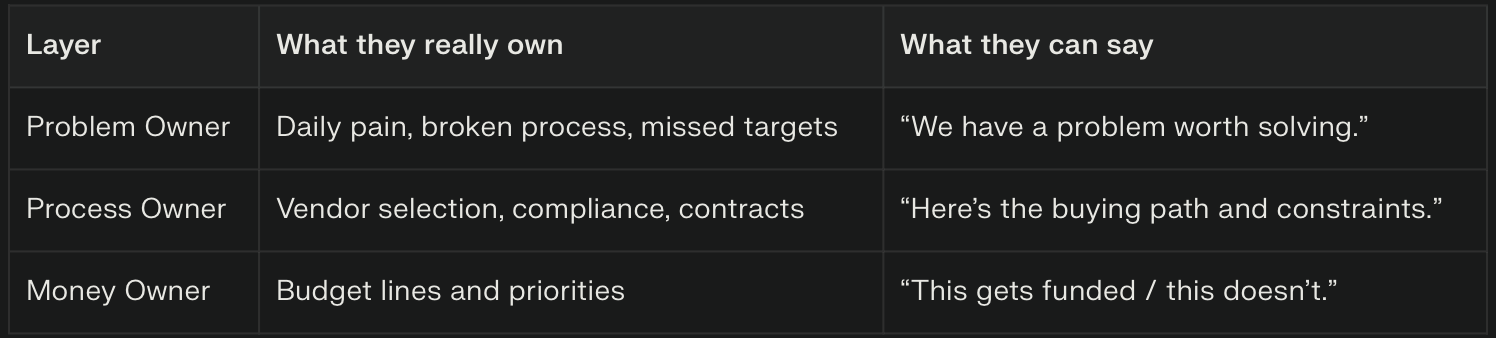
In many deals:
The Problem Owner lives in the business (Ops, Plant, Marketing, IT, Sales).
The Process Owner is Procurement (or sometimes IT, Legal).
The Money Owner is a director / VP / C‑level.
Trying to start with Procurement is like walking into a hospital and pitching an MRI machine to the billing department first.
Do we touch the process? Yes.
Do we feel your value in our daily work? No.
Rule #1: Start Where the Pain Lives, Not Where the Process Lives
If your product:
Changes how people work day‑to‑day
Shows its value in reduced manual work, better quality, fewer errors
Needs adoption, not just a signature
…then your first email should almost never go to Procurement.
It should go to the person whose team’s life you make less miserable.
Examples:
You sell QA automation for manufacturing?
→ Start with Head of Quality, Plant Manager, Production Manager – not Procurement.You sell a sales engagement tool?
→ Start with VP Sales, Head of SDR, Director of Revenue Ops – not Procurement.You sell marketing asset management?
→ Start with Head of Brand, Marketing Ops, Digital Lead – not Procurement.
Why?
Because:
Problem Owners feel your value.
Procurement manages your risk and price.
Wrong order:
You pitch Procurement.
Procurement thinks, “Who will even use this?”
We have to sell it internally for you. We won’t.
Right order:
You talk to Problem Owner.
They say, “This would actually help my team.”
They come to Procurement with: “Help me buy this.”
Now you’re no longer a cold caller.
You’re “the vendor my stakeholder wants”.
How to Map the Real Problem Owner in Under 10 Minutes
Let’s say you sell something. Before you open LinkedIn:
Ask yourself:
“If this never got implemented, who would keep suffering?”
Do this in two steps.
Step 1: Understand the workflow, not the org chart
Pick your product and complete the sentence:
“We reduce [concrete pain] in [concrete workflow] for [concrete team].”
Examples:
“We reduce last‑minute line stops in packaging for plant operations.”
“We reduce manual data entry in order processing for customer service.”
“We reduce unqualified demos in the pipeline for SDR/AE teams.”
“We reduce compliance review delays in contract workflows for legal + sales.”
Now answer:
Who gets yelled at when this goes wrong?
Who gets pulled into Friday “crisis calls”?
Whose KPIs are directly hit by this?
That’s your Problem Owner persona.
Only then go to LinkedIn.
Step 2: Use KPI clues instead of just titles
Search in your target account for:
Keywords in the “About” or “Experience” sections
Not just job titles
You’re looking for phrases like:
“Responsible for uptime of X”
“Accountable for OEE / scrap rate / yield”
“P&L owner for region / product line”
“Owning lead generation and SDR performance”
“Driving CX metrics like NPS, CES”
“Responsible for order-to-cash process”
You don’t need the perfect title.
You need someone whose success metric maps to your outcome.
That person is far more likely to feel this:
“If this works, it makes ME look good.”
If this lands with you so far, that’s exactly the kind of nuance paid readers get every second week – the actual order buyers want you to follow, not the one in generic sales playbooks.
When Procurement Is the Right First Contact
Sometimes, starting with Procurement is correct.
That’s usually when:
Your product is mostly about cost, terms, or risk reduction.
Day‑to‑day users are largely indifferent as long as things keep working.
The company is mature and highly process‑driven.
Examples:
You’re a second‑source supplier of a commodity part.
You’re offering lower logistics or warehousing cost with same service level.
You’re a framework agreement provider (office supplies, fleet, travel, MRO).
You’re a risk / compliance / supplier‑risk tool Procurement itself uses.
In those cases:
The Problem Owner is Procurement.
They own the KPI you improve (savings, risk, payment terms).
They are the most motivated champion.
Rule of thumb:
If your main slide is “we automate your work”, don’t start with Procurement.
If your main slide is “we make your spend safer / cheaper / more compliant”, starting with Procurement is fine.
If you want an upcoming article just on “How to not screw up the first email to Procurement”, drop that line in a reply – if enough people want it, it goes to the top of the queue.
The 3 Most Common Entry Mistakes (And What to Do Instead)
Mistake 1: Spraying one generic persona
You pick “Head of Sales” or “Head of IT” for every account, every time.
Result:
You hit people who are too senior to care about details but too busy to delegate the evaluation.
You get compliments and zero projects.
Do this instead:
Think in two levels:
Level 1: The hands‑on owner who feels the pain.
Level 2: The strategic owner who defends budget and priorities.
Example:
You sell something that affects SDRs:
Level 1: Head of SDR / SDR Manager
Level 2: VP Sales / CRO
Start with Level 1:
“Hey [Name], not sure if this is on your radar, but we’re seeing [very specific pain] on SDR floors a lot right now…”
Once you’ve had a meaningful conversation there, ask:
“If this was worth exploring, who usually needs to be involved above you to even consider it?”
Now you’re introduced UP instead of cold‑emailing down from the top.
If you’re reading this and thinking of an account where you clearly started at the wrong level, write it down – you’ll use it in a minute when we talk about sideways and upward moves in Part 2.
Mistake 2: Going straight for the highest title
You target:
CEO
COO
CIO
CPO
…for everything.
Will they open an email with a sharp subject line? Sometimes.
Will they themselves evaluate your tool or supplier? Almost never.
What usually happens:
They forward you down – with zero context.
The person receiving the forward sees you as a “task from the boss”.
They are now annoyed before you even talk.
Better approach:
Start at the smallest level where the pain is clearly felt AND someone can still move.
Then earn the right to be pulled up.
Rough rule:
If you sell a tool, start no higher than Director / Head of for the affected team.
If you sell a strategic managed service, Director/VP is fine – but still identify the operational manager underneath.
Mistake 3: Ignoring “who loses if this works”
Every solution creates winners and losers internally.
Winners:
People whose KPIs get better
Teams who can drop annoying manual work
Leaders who can claim the improvement
Losers:
Internal tools or teams you partially replace
People who lose budget or influence
Champions of the incumbent supplier
If you pitch to someone in the “loser” group as your first contact, they will:
Nod politely
Ask decent questions
Then quietly bury you
Before reaching out, ask:
“If this is wildly successful, whose budget or influence shrinks?”
Do NOT start there.
Start where:
“If this is wildly successful, whose life is easier and whose career story gets stronger?”
That’s your first “right person”.
Putting It Together: A Simple Targeting Map Per Account
For each target account, do this on one page:
Define the workflow and pain
“We reduce [X] in [workflow] for [team].”
List potential Problem Owners
Titles + responsibilities
Who gets blamed today?
List likely Process Owners
Procurement category owner
IT / Legal if it’s a tool
List likely Money Owners
VP / Director / BU Lead
Who has P&L or capex authority?
Pick your Entry Sequence
1st: Problem Owner (L1)
2nd: Strategic Owner (L2) – via intro if possible
3rd: Process Owner (Procurement / IT) when momentum exists
You’re no longer “searching for the right person”.
You’re designing an entry strategy that mirrors how buying actually works inside.
What’s Coming in Part 2
This was Part 1:
How to think about “the right person” like an insider – and how to identify the best first contact for your category.
In Part 2, we’ll go one level deeper and make it operational:
Concrete outreach templates tailored to Problem Owner vs. Process Owner vs. Money Owner
How to move sideways (“not me, but X”) without sounding desperate
How to move upwards without throwing your champion under the bus
How to involve Procurement at the right moment without triggering a process too early
Real examples of internal mail chains like:
“Vendor A wrote this → we forwarded like this → outcome”
If you want to make sure you don’t miss Part 2 (and the future articles that came from subscriber requests), hit subscribe now. Most of the playbooks you’ll see there don’t show up on LinkedIn – they live here.