
RFQ Process From A Purchasing Perspective: Why You're Losing Bids (And How to Win Without Being the Cheapest)

The €2 Million Mistake
Last month, a supplier lost a €2 million contract to a competitor who was 8% more expensive.
Not because their product was worse.
Not because they missed the deadline.
Because they made three critical mistakes in their RFQ response that screamed “we don’t understand procurement.”
By the end of this article, you’ll know exactly what those mistakes were - and what to do instead in your next RFQ, including the perfect RFQ template and follow-up messages.
If you want to save time and grow your sales with insider tips and templates weekly, hit subscribe!
Check out my LinkedIn message templates as well!
Now, let me show you what we’re really asking when we send an RFQ:
The RFQ Reality Most Vendors Miss
When you receive an RFQ (Request for Quote) from purchasing, you think you’re being asked one question:
“What’s your price?”
Wrong.
We’re actually asking five questions:
Can you deliver what we need? (Technical capability)
Will you deliver when we need it? (Reliability)
Can we trust you not to screw us? (Risk assessment)
How much work will you create for us? (Operational burden)
What’s your price? (Cost)
Price is question #5, not question #1.
But 90% of RFQ responses I receive answer question #5 and ignore questions 1-4.
Then vendors wonder why they lost to a “more expensive” competitor.
→ Here’s the truth: We score RFQ responses on multiple factors, not just price.
Last quarter, I evaluated an RFQ where the winning vendor was 8% more expensive but scored 40% higher on total evaluation criteria.
Let me show you the actual scoring breakdown and the three mistakes that kill RFQ responses before we even look at price.
The Three RFQ Killers
KILLER #1: The PDF Brochure Response
What vendors send:
Your RFQ asks for:
Lead time for 10,000 units
Quality certifications
Payment terms
Delivery logistics
What I receive:
A 40-page PDF company brochure with:
Company history since 1987
Photos of your factory
Generic capability statements
Your entire product portfolio
Zero answers to my actual questions.
→ Why this fails: I have 8 RFQs to evaluate this week. I don’t have time to hunt through your brochure for the answers I specifically requested.
Your competitor answered my questions in a clean Excel table on page 2.
Guess who advanced to the next round?
The Fix:
Create an RFQ response with these sections:
Section 1: Executive Summary (1 page)
Your price
Your lead time
Your key differentiator for THIS specific RFQ
Section 2: Technical Compliance Matrix (1 page)
A simple table:

Every line item from our RFQ gets a row.
→ This single page tells me everything I need in 30 seconds.
Section 3: Commercial Terms (1 page)
Pricing breakdown
Payment terms
Warranty
Volume pricing tiers
Section 4: Risk Mitigation (1 page)
Quality certifications
Production capacity (proves you can handle our volume)
References from similar projects
Total: 4 pages of actual answers + appendix.
Not 40 pages of marketing.
KILLER #2: The “We Can Do Everything” Trap
What I see constantly:
RFQ asks for: CNC machined aluminum parts, tolerance ±0.05mm
Vendor response:
“Yes, we can do this! We also offer plastic injection molding, sheet metal fabrication, assembly services, packaging, global logistics...”
→ Why this kills you:
When you claim you can do everything, I believe you’re good at nothing.
Specialists beat generalists in RFQs every single time.
Real example from last quarter:
Two quotes for precision titanium components:
Vendor A: “We’re a full-service manufacturing partner offering CNC, casting, assembly, and logistics.”
Vendor B: “We specialize exclusively in titanium machining for aerospace and medical devices. 15 years experience, AS9100 certified, dedicated titanium-only production line.”
Vendor B won at 12% higher price.
The Fix:
In your RFQ response:
❌ Don’t mention capabilities we didn’t ask for
❌ Don’t pitch “additional services”
❌ Don’t position as “one-stop shop”
✅ Do this:
“We specialize in [exact capability from RFQ]. We’ve produced similar parts for [relevant industry] with [specific quality standard]. Our production line is dedicated to this process, ensuring consistent quality.”
Show depth in what we asked for, not breadth in what we didn’t.
KILLER #3: The Pricing Mystery
What vendors send:
“Price: €24.50 per unit”
That’s it. One line.
What I need to know:
Is that at 100 units or 10,000?
Does it include tooling? (€15k surprise later?)
What about shipping? (€8k surprise?)
Payment terms? (Net 60 vs COD = huge difference)
Price valid for how long?
Volume breaks?
→ Why this creates problems:
I can’t compare your €24.50 to competitor’s €26.80 because I don’t know what’s included.
Your competitor sent this:
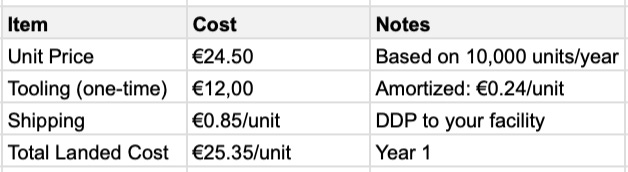
→ This takes 10 minutes to create.
→ It eliminates 90% of my follow-up questions.
→ And it makes you look professional, not sketchy.
Now Here’s What Really Decides RFQ Winners
Those three mistakes will disqualify you.
But avoiding them just gets you into the evaluation phase.
What happens next is where most vendors lose - even with good RFQ responses.
→ Because we use a hidden scoring matrix that weights 5 factors.
And price? It’s only 30% of the decision.
Here’s the actual matrix I used last month for that €2M contract...
Paid subscribers get:
The exact scoring matrix we use (with real weightings for each factor)
The complete RFQ response checklist (what to include before you hit send)
The follow-up strategy that doesn’t annoy procurement (with word-for-word email template)
Subscribe now and save loads of time you could spent for attracting more customers.
Costing you less than two coffee…
The Hidden Scoring Matrix
Here’s my actual scoring matrix for that €2M CNC parts RFQ:
